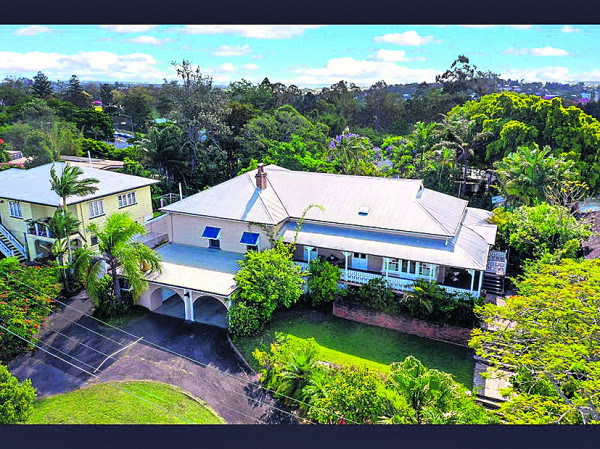
THE owners of one of the city’s historic homes have decided to sell and are interested in offers over $1,100,000.
Walkerville in Cintra Street Eastern Heights was built around 1909 however its original address was on Bergins Hill and according to descendants of the Walker family, it was moved by bullock team to Limestone Hill when an allotment became available in 1918.
The home was built for John and Ellen Walker. John Fulton Walker was one of the lesees of the Aberdare Colliery at the time. The story begins one generation back when William George Walker emigrated to Australia from England. He married Isabella Perry and the couple became the parents of nine sons and one daughter. Seven of the sons survived childhood, and in 1900, four of them, Henry, Alexander, Robert and John, plus their brother-in-law, William Miller, formed the company known as Walker and Co.
Their father, William George (WG) Walker, on his arrival in Moreton Bay followed the gold rush to New England, failed to find much gold, gained a paying job and brought his saving to Brisbane where he started a carting business from Brisbane to the inland and bringing back his teams laden with wool to Ipswich for transport by water to Brisbane and beyond.
WG was among the first settlers in the Rosewood district. His fifth son, John Fulton Walker, was born in Walloon in 1873. When he reached the age of 12, he was put through his paces in the coal mine leased by his father, which was known as Boxwood. He gained further experience in other mines before joining his brothers and brother in law in forming the firm of Walker and Co.
The firm first leased 112 acres of the Cooneanna Estate and named the colliery they established on that land, Fairbank.
Next, they leased the Aberdare Colliery from the Coal King, Lewis Thomas. Their next venture was to extend the firm further by opening up the Aberdare Extended colliery.
John Walker married Ellen Hudson in the same year Walker and Co was formed. He commissioned the building of Walkerville and in 1918, moved it to Limestone Hill where it was extended to accommodate their growing family.
About 1950 the home was converted into flats; very common after the second world war when there was a huge shortage of accommodation.
Just over three decades later it was restored to its original form and has now been returned to its former glory.
The home’s features include the imposing cedar entry with original lead light panel and side lights, large rooms with pressed metal ceilings and French doors out onto the verandah and a fireplace in the large drawing room.
There are five large bedrooms. The master bedroom has a walk through robe to the large ensuite with step up bath and separate shower.
This bathroom is ‘two-way’ to the hall and services two further bedrooms in the front section of the house.
Three sets of French doors open from the front parlour and at the end of the hall and front section a door opens into the drawing room.
Another two bedrooms are located in the same vicinity. The solid timber kitchen has a breakfast nook, bridge fireplace with pot belly heater and views across to the verandah. A second bathroom is located in this section.
The house yard affords privacy and has a large flat grassed area and a resort style swimming pool.
Two car undercover accommodation is provided at the front of the 1538sqm allotment.