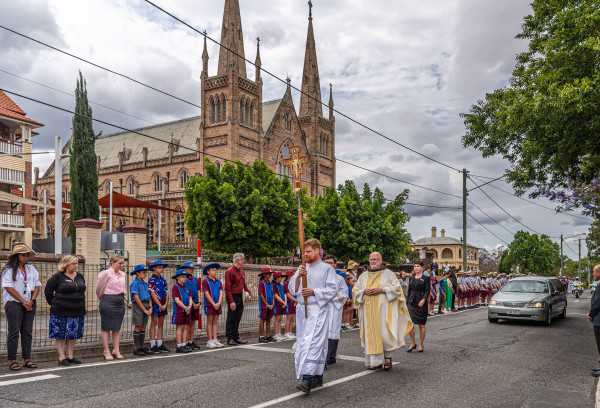
FORMER Federal Leader of the Opposition and Governor-General Bill Hayden was remembered as a national leader, a man who defined the modern Labor Party, a humble achiever who introduced major social security reforms and policy change and a family man.
Prime Minister Anthony Albanese referred to him as a “legend of the labour movement”.
Former Prime Minister Paul Keating recognised an array of his achievements in office along with a moment of irony which can only come with a life in politics.
Mr Keating recalled a moment when Hayden, who as leader of the opposition could have led Federal Labor to victory in the 1980 election, served as Governor-General.
“He had wry moments during this period. He was at Government House to receive Bob Hawke’s resignation as prime minister and happily for me, my appointment in his place,” Mr Keating said.
“On the principle of what goes around comes around, Bill will have taken some gratification from Hawke’s demise, though the stiff upper lippedness of the job would have prevented him from exhibiting even a hint.”
The Prime Minister and former Prime Minister joined Premier Annastacia Palaszczuk, Governor-General David Hurley, Governor of Queensland Jeannette Young, former Governors-General, Federal Treasurer Jim Chalmers, current and past Ministers, Senators and MPs at St Mary’s Church on Friday to honour Bill Hayden at a State Funeral.
Mr Hayden was elected to Federal Parliament as Member for Oxley in 1961 and served as Minister for Social Security and Treasurer in the Whitlam Government, Leader of the Federal Labor Party, Minister for Foreign Affairs and Trade in the Hawke Government and as Australia’s 21st Governor-General from 1989 to 1996.
Mr Keating spoke of Hayden’s hallmark achievements in establishing Medibank and his achievements as Foreign Minister in the Hawke Government and spoke of his success in re-establishing Federal Labor in his time as opposition leader as his crowning achievement.
“Labor had just but three years in elected office in the previous 30. Bill Hayden rescued and resuscitated the Labor Party as a national force,” he said.
“This period picked Bill out as the likely successor to Gough Whitlam as party leader and as we know, after a two year gap, 1975 to ’77 when Bill was not sure whether he wished to be in the game any longer, he replaced Gough as leader of the parliamentary Labor Party and leader of the opposition.
“It was in this role that Bill really hit his straps. Out of the mayhem of earlier years, he brought order, focus and policy consistency to the shadow cabinet and put together a talented front bench committed to principles of rationality and accountability.
“The front bench became the turning force … It did not take Bill too long to make inroads into then Malcolm Fraser’s standing in the polls. He managed to narrow the gap so sharply at the subsequent 1980 election … so as to bring Labor to a margin of just 0.8 percent In the two party preferred vote behind the coalition.

“This lift in the national vote affirmed his relevance as a parliamentary figure. But he did more than that. With a tail wind of the upbeat, 1980 result behind him, he tightened and strengthened his front bench to take the fight to Fraser and his government.
“But his success at the 1980 election also brought Bob Hawke into the House of Representatives. And as people well know, it was Hawke’s national reputation, his self-assuredness, the ego-driven sense of destiny that led him to replacing Bill Hayden as leader on the cusp of the 1983 election.
“Bill’s humility could cope with much adversity, but not with the ruthlessness of Hawke, backed as he was by the industrial movement.
“The Hawke Government, put together by Bill Hayden, superintendent of the largest and most defining set of policy changes that Australia had ever seen, setting Australia up for 30 consecutive years of low inflationary growth, an international record that remains unsurpassed to this day. Bill is not with us to take a bow but he certainly earned one.”
Mr Albanese said Hayden gave the Australian Labor Party the chance of a future.
“Some giants cast a shadow but Bill Hayden was not one of them. With his quiet strength of character, this legend of the labour movement shone the light that let us see the road ahead.
“As we mourn him in death, we celebrate what his life meant in all of its integrity, all of its substance, and importantly, all of its consequence. We take heart from all that Bill made possible, and every life that he changed for the better, including mine.
“The truth is that Bill Hayden didn’t just light the road ahead. He did so much to lay its foundations.
“We can be grateful that this child of the Depression, turned police officer, joined the Australian Labor Party to advance his values.
“There must have been times when life in the Labor Party struck Bill as more challenge than solution. In the aftermath of 1975, he was the last Labor MP left standing from the House of Representatives in Queensland. He served as leader through six hard years in opposition, only to be denied at the last moment, the chance to lead the party to an election many believe that he would have won.”
“He may never have resided in the Lodge, but Bill Hayden was the fulcrum on which the Labor Party’s fortunes turned for the better.”