INTERNATIONAL Air Cadets recently visited RAAF Base Amberley on a two-week exchange program.
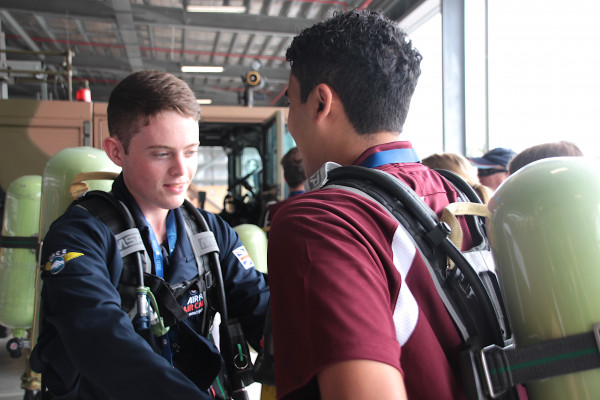
About 25 cadets from the United Kingdom, Belgium, the United States, New Zealand and the Republic of Korea toured Amberley’s History and Heritage Centre, met 9th Force Support Battalion mascot camels Penny and Vernon, learned about flightline fire suppression at 23 Squadron and inspected facilities at the base gym.
The Amberley visit was the final stop in Brisbane on a program, which had been on a four year hiatus due to the pandemic.
The program included being flown to Canberra on a C-27J Spartan, a VIP dinner with Chief of Air Force Air Marshal Robert Chipman and an excursion to 100 Squadron in Temora, NSW, as well as visits to the National War Memorial and Australian National Museum.
Republic of South Korea Air Cadet, Hojoong Yun, 21, said he was “very impressed” with Amberley Heritage Centre’s Korean War display and that the visit to a working air base was a significant highlight.
British Cadet, Alex Day, 20, who worked on Sea King helicopters as part of a Diploma in Aerospace Engineering, was fascinated by the Heritage Centre’s restored Vietnam-era helicopters.
Mr Day said his work for Lord-Lieutenant Mohammed Saddiq, and six years in Air Cadets had taken him all over the world. This was his first Australian visit.
For 18-year-old US Cadet Ishan Swali, who will begin an Aerospace Engineering Program at Georgia Institute of Technology next year, Air Cadets and the pilot training it offers is an essential step towards his goal of joining NASA’s astronaut program.
The cadets, who ranged in age from 18 to 21, were the “cream of the cream” of their home country’s future aviators, according to Squadron Leader Cash.
“Cultural exchanges like this make a huge contribution to the personal development of tomorrow’s aviators as well as nurture goodwill among our allies,” he said.
The program began in 1947 when Canada and the United Kingdom arranged a bilateral exchange of cadets.
Over the next few years, the scheme was adopted in the US and several European countries.
The scheme now has a membership of 20 nations including Australia, New Zealand, Singapore, Hong Kong, and Japan.