IPSWICH dumps are never out of the headlines for long but, in 2011, they were in the news for entirely different reasons.
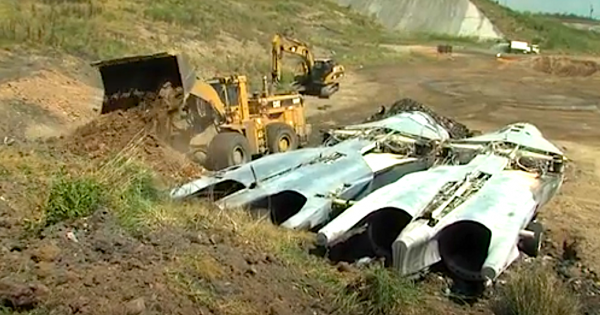
The sight of F-111s being “unceremoniously dumped in a rubbish tip” at Swanbank caused the raising of more than a few eyebrows.
Ipswich’s iconic F-111 aircraft were buried at Swanbank Industrial Park when the Defence Materiel Organisation (DMO) arranged for 23 of the decommissioned aircraft to be dumped between November 21 and 23, 2011.
It was a requirement of the military arrangement with the US that the aircraft be disposed of. Only the fuselage was buried, with wings, stabilisers and tails removed for scrap.
The fuselages were made of bonded panels that used asbestos and burying them was seen as the best way of removing the hazard.
Trying to recover the materials was not cost effective, and it was full of hazards requiring a comprehensive facility and PPE to even attempt.
The F-111, which entered service in the ’60s, called Amberley Airforce home.
The Australian government ordered 24 F-111Cs to equip the Royal Australian Air Force (RAAF) in 1963, but the aircraft were not delivered until 1973 because of long-running technical problems.
Four ex–US Air Force (USAF) F-111As were boughtt by Australia and converted to F-111C standard in 1982 to replace F-111Cs destroyed in accidents.
In Australian aviation circles, the F-111 Aardvark was known as the Pig because of its long snout and terrain-following ability.
The operational career of the F-111 concluded on December 3, 2010, at RAAF Amberley when crew in an F-111C of the RAAF touched down for the aircraft’s last landing.
Following the F-111s’ retirement, 13 of the surviving aircraft (12 F-111Cs and a single F-111G) were preserved in aviation museums and RAAF air bases.